
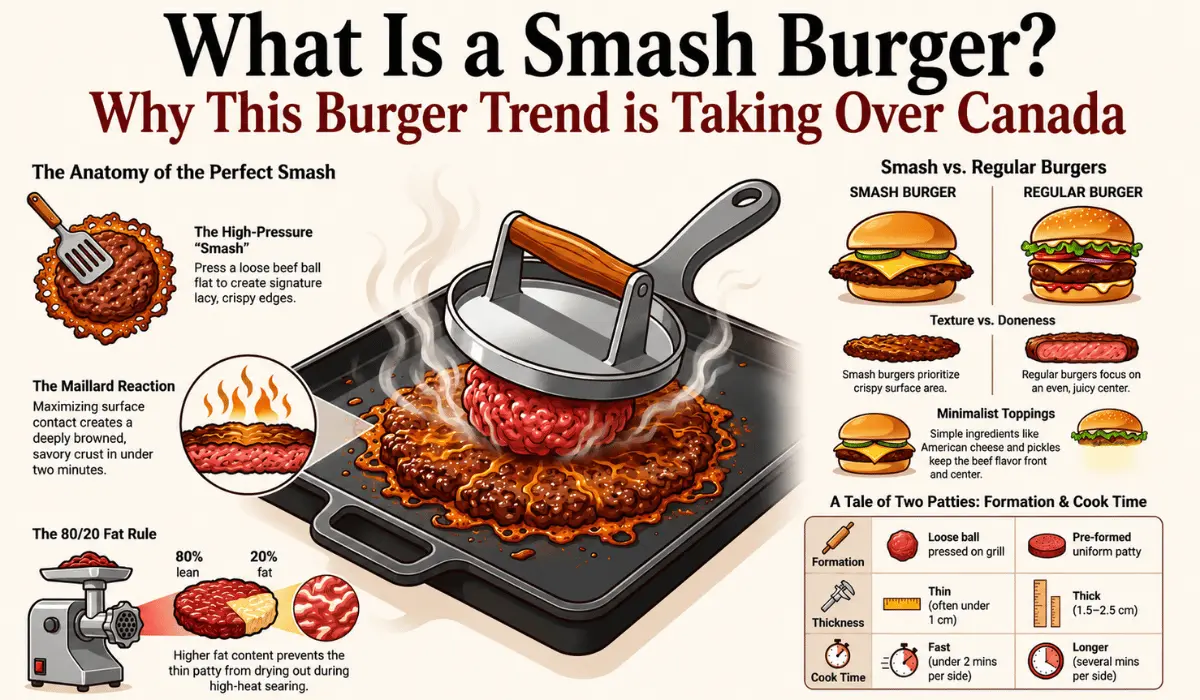
A smash burger isn’t a different kind of beef, a different bun, or a different topping combination. It’s a different amount of pressure. Take a loose ball of ground beef, press it flat against a screaming-hot griddle, and you get something a regular burger patty never quite achieves: a lacy, deeply browned crust on a patty thin enough to cook through in under two minutes. That one change in technique is why smash burgers have gone from a diner curiosity to one of the fastest-growing burger styles on Canadian menus.
What Makes a Burger a “Smash Burger”
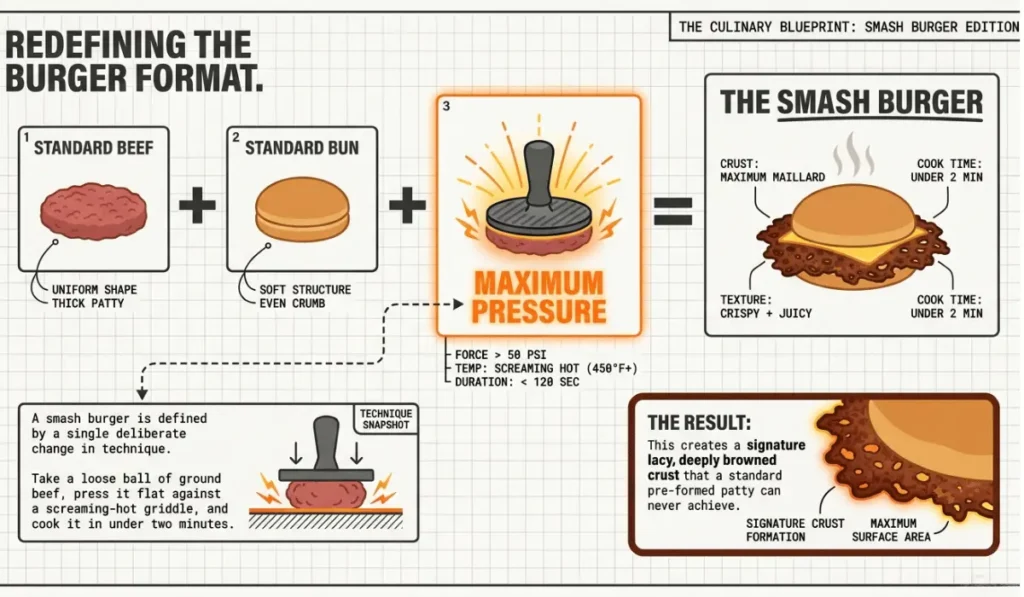
A smash burger starts as a loosely packed ball of ground beef, not a pre-formed patty. It’s placed on a hot flat-top or heavy skillet and pressed down hard with a spatula or metal press until it spreads into a thin, wide patty with ragged, uneven edges.
That pressing step does two things at once. It maximizes the beef’s contact with the hot surface, which drives the Maillard reaction — the browning process responsible for the deep, savoury crust on seared meat. And it creates more surface area relative to thickness, so the patty cooks fast, develops crispy edges all the way around, and stays juicy in the short time it’s on the heat. A regular burger patty, by comparison, is thicker, cooked more gently, and aims for an evenly pink or well-done centre rather than a maximally browned surface.
Where the Technique Actually Came From
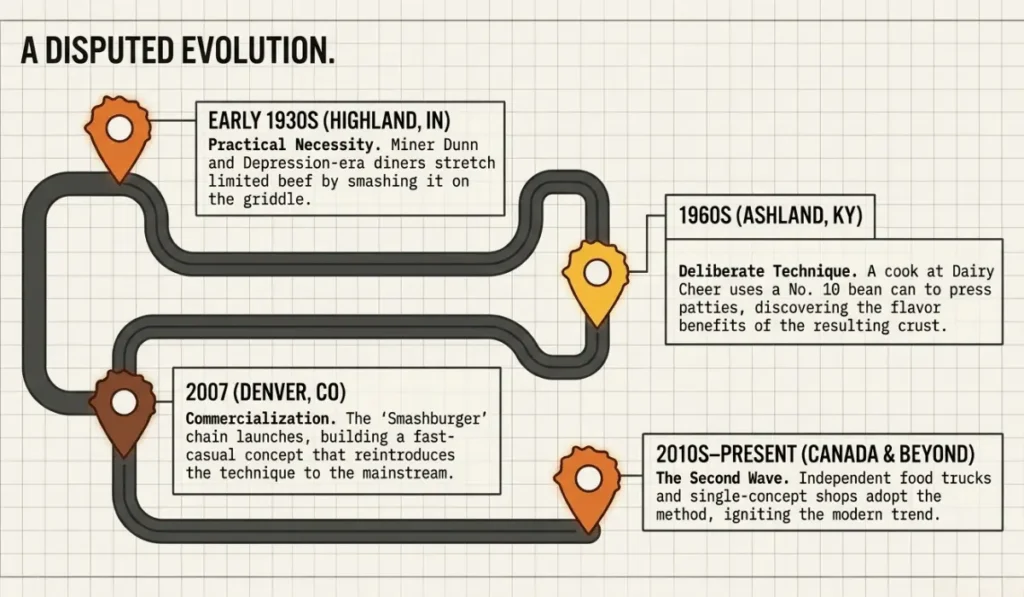
The smash burger’s popularity is recent, but the technique itself isn’t new — and its exact origin is genuinely disputed rather than settled.
The most commonly repeated story credits a cook at Dairy Cheer, a small diner in Ashland, Kentucky, who in the 1960s used a No. 10 bean can to press a ball of ground beef onto a hot griddle, discovering that the technique produced a crispier, more flavourful patty than a standard formed one. Owner Bill Culbertson is often credited with recognizing and popularizing the method from there.
That story has been challenged by food writers who point to earlier evidence of smashed-style patties. Restaurants such as Miner Dunn in Highland, Indiana, are documented serving a similar smashed, onion-heavy patty as far back as the early 1930s, likely developed as a practical way to stretch a limited amount of beef during the Great Depression rather than as a deliberate flavour technique. Because smashing ground beef onto a hot surface is a fairly obvious cooking instinct once you have a griddle and a spatula, it’s plausible the method was independently discovered in multiple diners before anyone thought to name or promote it.
What’s clearer is how the style re-entered the mainstream. The technique stayed a regional diner habit for decades before the Denver-based chain Smashburger, founded in 2007, built an entire fast-casual concept around it and helped reintroduce the method to a much wider audience. Independent restaurants and food-truck operators picked up the same approach through the 2010s, and it’s that second wave — driven by small, single-concept burger shops rather than one chain — that’s largely responsible for the current trend.
The Ingredients Behind a Smash Burger
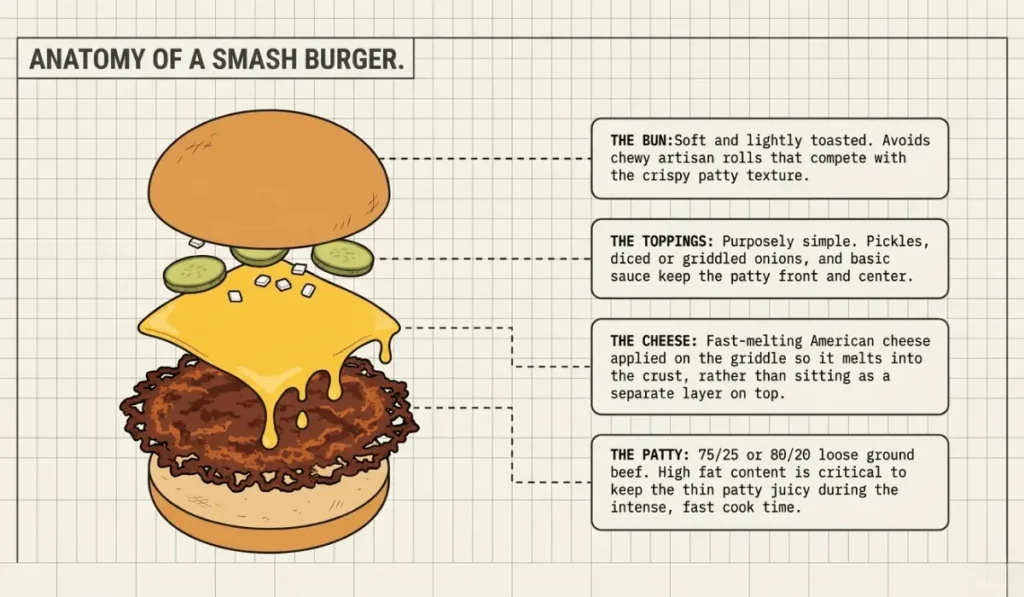
Smash burgers work because of a few deliberate choices, not a long ingredient list:
Ground beef with higher fat content (commonly around a 75/25 or 80/20 lean-to-fat ratio) keeps the thin patty juicy despite the high heat and fast cook time. Leaner beef tends to dry out before it develops a proper crust.
A very hot, flat cooking surface — a griddle, flat-top, or heavy cast-iron pan — is essential, since the crust depends on high, even, sustained heat rather than a quick sear.
A stiff, wide spatula or dedicated smash press applies firm, even pressure in one motion. Pressing too gradually, or repeatedly, lets juice escape and can leave the centre dry.
American cheese or another fast-melting cheese is typically added while the patty is still on the griddle, so it melts into the crust rather than sitting on top as a separate layer.
A soft, lightly toasted bun is preferred over a dense artisan roll, since the burger’s appeal is built around contrast between the crisp patty edge and something soft, not a chewy bread competing for texture.
Toppings tend to stay simple — pickles, diced or griddled onions, and a basic sauce — because the smash technique is designed to put the patty itself front and centre rather than build a tall, heavily dressed sandwich.
Smash Burger vs. Regular Burger
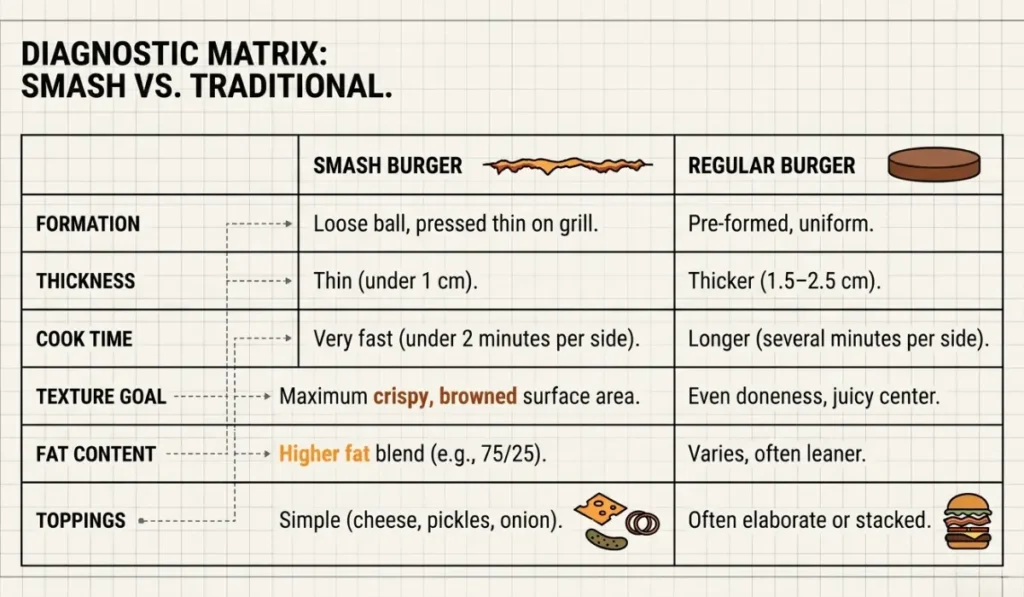
| Comparison Factor | Smash Burger | Regular Burger |
|---|---|---|
| Patty formation | Loose ball, pressed thin on the grill | Pre-formed, uniform thickness |
| Patty thickness | Thin (often under 1 cm) | Thicker (typically 1.5–2.5 cm) |
| Cook time | Very fast, often under 2 minutes per side | Longer, several minutes per side |
| Texture goal | Maximum crispy, browned surface area | Even doneness, juicy centre |
| Fat content used | Higher fat blend (e.g., 75/25) | Varies, often leaner |
| Typical toppings | Simple — cheese, pickles, onion, basic sauce | Often more elaborate or stacked |
How Smash Burgers Are Served in Canada
Most Canadian smash burger menus keep the format close to its diner roots: a single or double patty, a slice of melted cheese, pickles, onion, and a basic sauce on a soft bun, sometimes offered alongside a “double” or “triple” stacked version for people who want more beef without a thicker patty. Some shops add regional or house-specific touches — a pastrami-style smash burger has appeared on Toronto menus, for example, and a few Alberta-based spots emphasize locally sourced beef and dairy as a selling point rather than changing the technique itself.
Why the Trend Has Taken Off in Canada
A few practical factors explain why smash burgers have spread through Canadian cities faster than most other recent food trends.
The format is inexpensive to execute well. A flat-top, a spatula, and a simple beef-cheese-bun combination require far less specialized equipment or ingredient cost than many other trending foods, which makes it an accessible concept for independent operators and food trucks rather than only large chains.
It’s also highly visual. The crispy, lacy edge of a smash patty photographs and films well, which has helped the style spread through social media in a way that’s harder to achieve with a standard burger. Several independent Canadian burger shops that built early buzz — including Toronto and Calgary spots that started as pop-ups before opening permanent locations — grew largely through word of mouth and social sharing rather than traditional advertising.
Finally, the smash technique solves a genuine complaint about thicker burgers: an oversized, hard-to-bite patty that’s often undercooked in the middle. A thinner, fully seared patty avoids that problem entirely, which appeals to people who want a burger that’s easy to eat in a few bites without sacrificing flavour.
Why It’s More Than a Passing Trend
The smash burger’s staying power comes down to the fact that it isn’t really a new dish — it’s an old, practical cooking method that happens to solve a real problem with the standard burger. That’s a different kind of trend than something built around a novel ingredient or a single viral menu item, which tends to fade once the novelty wears off. Because the appeal is rooted in genuine texture and flavour improvements rather than presentation alone, smash burgers look more likely to become a permanent fixture on Canadian burger menus than a passing craze.
Common Questions About Smash Burgers
Do smash burgers use different beef than regular burgers?
Not necessarily a different cut, but often a higher fat percentage, since the thin patty and fast cook time leave less margin for a leaner blend to stay juicy.
Can you make a smash burger without a griddle?
Yes — a heavy cast-iron skillet on high heat works, as long as it retains heat well and gives you a flat, wide surface to press against.
Why do smash burgers have ragged, uneven edges?
The loose ball of beef doesn’t have a defined shape before it’s pressed, so it spreads unevenly and creates the thin, crispy, irregular edge that’s become the style’s signature look.
The Bottom Line
A smash burger is defined by one deliberate choice — pressing a loose ball of beef hard onto a very hot surface — and everything else about the style follows from that decision. Its exact origin may be genuinely unclear, split between a 1960s Kentucky diner and earlier Depression-era smashed patties, but its current popularity in Canada is easy to explain: it’s a simple, affordable technique that produces a genuinely better burger, and independent shops across the country have built entire menus proving it.
