
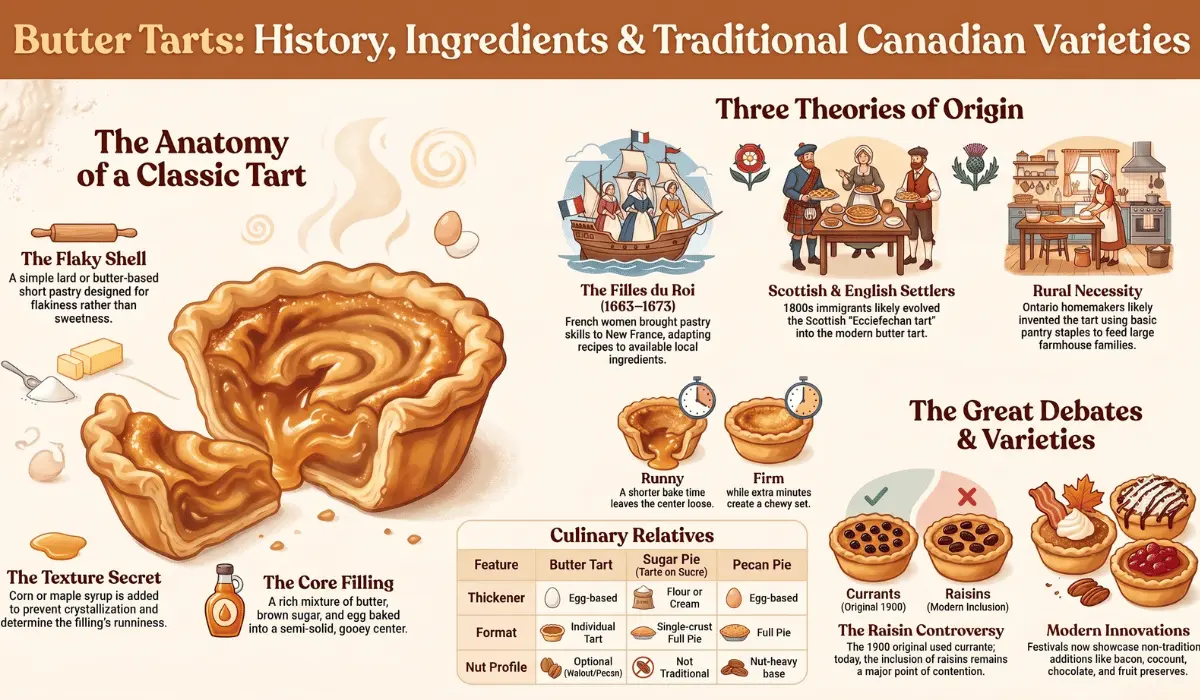
Few Canadian desserts start as many arguments as the butter tart. Ask a room full of Canadians whether raisins belong inside one, or whether the filling should be runny or firm, and you’ll get a debate rather than an answer. That disagreement is part of what makes the butter tart interesting: it’s a dessert with no single fixed recipe, no confirmed inventor, and a history that food historians still can’t fully agree on.
What a Butter Tart Actually Is
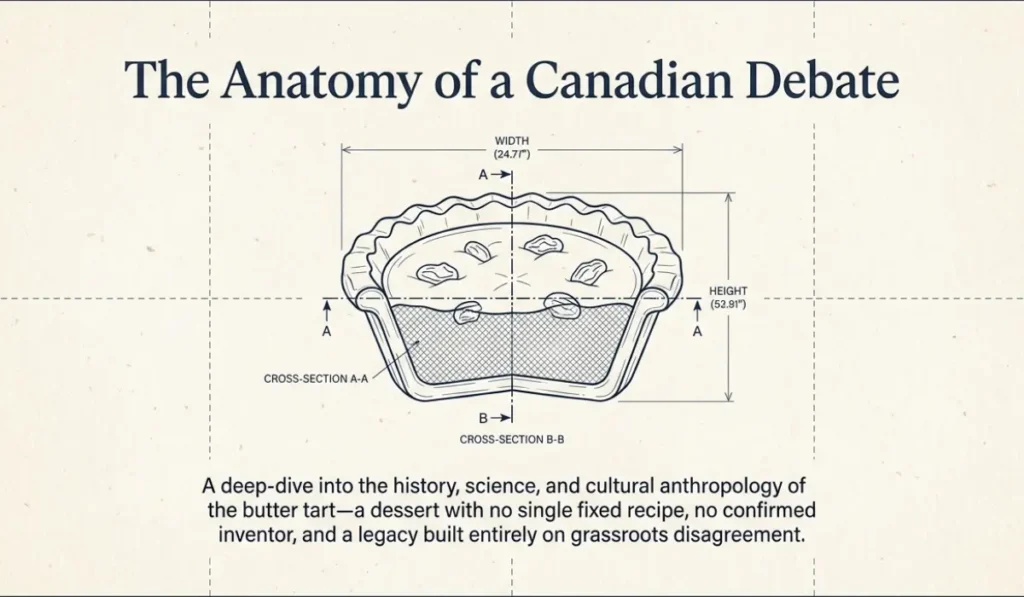
A butter tart is a small pastry shell filled with a mixture built from butter, sugar, and egg, baked until the filling turns semi-solid with a slightly crisp top and a soft, gooey centre. Some versions use corn syrup or maple syrup in place of some of the sugar, which changes both the flavour and the texture of the filling.
The result sits somewhere between a pecan pie filling and a caramel custard — sweet, buttery, and rich enough that one tart is usually a full serving. Because the recipe is so simple, small changes in ratio or bake time produce noticeably different results, which is a big part of why home bakers across the country have never settled on one “correct” version.
Where the Butter Tart Came From
The exact origin of the butter tart isn’t confirmed, and food historians point to a few different explanations rather than one accepted story.
One theory traces it back to the filles du roi, the young French women sent to New France between 1663 and 1673 to help establish the colony. According to this account, they brought European pastry knowledge with them and adapted it to the ingredients available, eventually producing something close to the modern butter tart. This theory links the tart to Quebec’s sugar pie, a single-crust pie made with flour, butter, and cream that shares a similar flavour profile.
A second theory points to Scottish and English settlers from the border counties between the two countries, who arrived in Canada through the 1800s. These settlers were familiar with Ecclefechan tarts, a Scottish pastry filled with butter, sugar, and dried fruit. Food writer Elizabeth Baird has argued that this dried-fruit tart, baked in a pie tin rather than individual shells, likely evolved into the butter tart as it took root in rural Ontario.
A third view, offered by culinary historian Liz Driver, is less romantic and possibly more accurate: rural Canadian homemakers simply combined the ingredients they had on hand — butter, eggs, flour, lard, and brown sugar — into a tart that was cheap to make and easy to feed to a farmhouse full of people. Driver has pointed out that Canadians tend to assume their food must have come from somewhere else, when the more likely explanation is that ordinary cooks in rural Ontario invented it themselves out of necessity.
What’s easier to confirm is when the butter tart entered the written record. The earliest known published recipe appeared in 1900, in the Women’s Auxiliary of the Royal Victoria Hospital Cookbook from Barrie, Ontario, credited to Mary Ethel MacLeod. That early version used currants rather than raisins. The tart’s popularity grew through the early 1900s, helped along by its inclusion in the widely distributed 1913 Five Roses Cook Book, which put a version of the recipe into kitchens across the country.
Ingredients That Define a Butter Tart
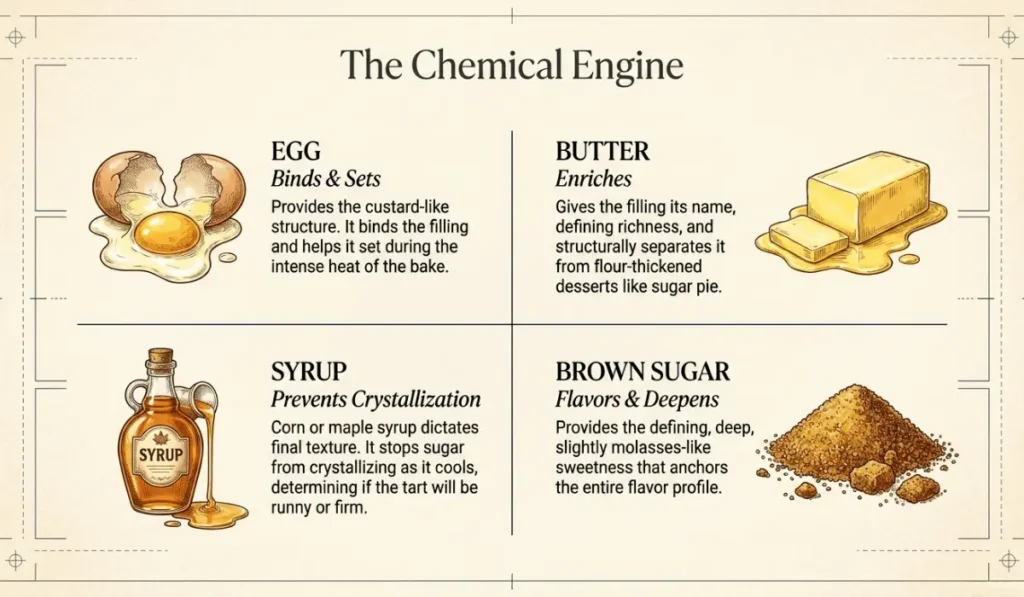
A traditional butter tart filling is built from a small number of ingredients, and each one does specific work:
Butter gives the filling its richness and its name, and separates the tart from similar desserts like sugar pie, which typically use less butter and more flour as a thickener.
Brown sugar provides the deep, slightly molasses-like sweetness that defines the flavour.
Corn syrup or maple syrup is used in many versions to keep the filling from crystallizing as it cools, and it’s largely responsible for whether a tart turns out runny or firm.
Egg binds the filling and helps it set during baking, giving the finished tart its custard-like structure.
Pastry shell is typically a simple butter or lard-based short pastry, chosen for flakiness rather than sweetness, since the filling already carries most of the sugar.
Optional add-ins — raisins, currants, walnuts, or pecans — sit on top of this base filling rather than replacing any part of it, which is why the raisin debate is really about topping, not about the tart’s fundamental structure.
How Butter Tarts Are Made and Served
The filling is mixed cold or at room temperature, poured into unbaked tart shells, and baked at a fairly high heat for a short time — commonly around 15 to 20 minutes. The exact bake time is where the runny-versus-firm split comes from: a shorter bake leaves the centre loose enough to spill out when bitten into, while a few extra minutes sets the filling into a denser, chewier texture that holds its shape.
Neither version is more “correct” than the other. The difference largely comes down to family habit, and bakers tend to defend their preferred texture with surprising conviction. Butter tarts are almost always served at room temperature or slightly warm, on their own, without icing or additional garnish — the filling itself is meant to be the entire point.
Regional and Cultural Variations
Because the butter tart spread through home kitchens rather than commercial bakeries, it picked up regional habits rather than one standardized regional style.
In Ontario, where the tart has the deepest documented roots, the debate over raisins is taken seriously enough to shape entire local food events. The town of Midland hosts an annual butter tart festival where dozens of bakers compete for top honours, drawing tens of thousands of visitors. North of Guelph and through the Kawarthas and Northumberland County, self-guided butter tart trails link small bakeries that each put their own spin on the recipe.
Beyond the classic raisin-or-plain divide, bakers across the country have pushed the format in less traditional directions, adding ingredients like bacon, coconut, chocolate, or fruit preserves to the base filling. These variations tend to appear at bakeries and festivals rather than in home recipes passed down through families, where the plain butter-sugar-egg version, with or without raisins, remains the norm.
Quebec’s closest relative to the butter tart is the sugar pie (tarte au sucre), which uses a similar flavour base but is baked as a full pie rather than individual tarts, and typically relies more on flour or cream to thicken the filling instead of egg.
Storing and Freezing Butter Tarts
Butter tarts keep well at room temperature in a sealed container for a few days, and they freeze well for longer storage — most bakers recommend freezing them in their shells and thawing at room temperature rather than reheating, since reheating can cause the filling to run. Runny-filling versions are more fragile to transport and freeze than firm versions, which is worth considering before shipping or stacking a batch.
What the History Tells Us
The butter tart’s disputed origin isn’t a gap in the research — it’s a fairly accurate reflection of how the dessert actually spread. It wasn’t introduced by a single baker, a single restaurant, or a single published cookbook that everyone copied. It grew out of ordinary rural kitchens that had similar ingredients on hand and similar reasons to use them, which is exactly why no two families’ recipes match, and why the raisin and texture debates have never really been resolved. The disagreement is, in a strange way, the most authentic part of the tradition.
Common Questions About Butter Tarts
Are butter tarts only from Ontario?
Ontario has the strongest documented claim, including the earliest known recipe, but butter tarts are made and eaten across the country, from Newfoundland to British Columbia.
Why do people disagree so strongly about raisins?
Because the earliest recorded recipe used currants rather than raisins, and because the tart spread through countless individual households rather than one standardized source, there was never a single “official” version to settle the question.
Is a butter tart the same as a pecan pie?
The two share a similar sweet, egg-set filling, but butter tarts are smaller, individually shelled, and traditionally don’t rely on nuts as a base ingredient — nuts are typically an optional addition rather than a defining feature.
