
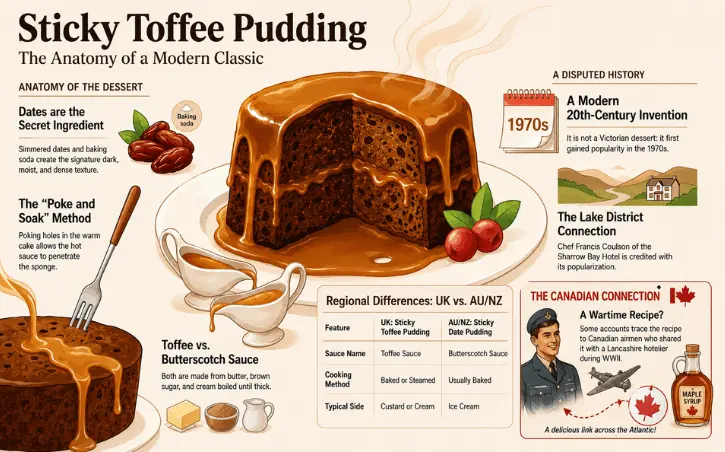
Sticky toffee pudding is a warm, moist sponge cake made with finely chopped or pureed dates, baked until dense and dark, then soaked in a hot toffee or butterscotch sauce made from butter, brown sugar, and cream. It’s usually served warm, cut into squares or turned out of individual molds, and topped with vanilla ice cream, custard, or softly whipped cream.
Despite the name, it isn’t a “pudding” in the boiled or steamed British sense, like a Christmas pudding or spotted dick. It’s closer to a baked sponge cake, and its batter behaves more like a rich muffin mix than a classic sponge. What makes it distinctive is the dates: they’re softened, often blended into a near-paste, and folded into the batter, where they break down during baking to give the cake its signature moisture and deep colour.
Where Sticky Toffee Pudding Comes From
Sticky toffee pudding’s history is genuinely disputed, and food historians haven’t settled it. The dessert is most closely associated with Britain’s Lake District, particularly the Sharrow Bay Hotel in Cumbria, where chef Francis Coulson served it at some point in the 20th century. According to Encyclopaedia Britannica, its popularity is generally thought to have spread across the country from there.
Where Coulson got the recipe is where the story splits. One account credits his business partner with developing the dessert after being inspired by wartime use of maple syrup. A separate, more widely repeated version holds that two Canadian soldiers stationed in Britain during the Second World War shared the recipe with a Lancashire hotelier, who later passed it on to Coulson, who adapted it before adding it to the Sharrow Bay menu. Some writers connect that Canadian link to a traditional steamed date dessert called brown Betty, though this remains a theory rather than a documented fact.
Other origin claims exist too. Two Scottish hotels — the Udny Arms and the Saplinbrae House — have both been credited with early versions, and a separate story ties the dish to the Lake District village of Ullswater rather than Sharrow Bay directly. Because so few written records survive from the dessert’s early years, no single account can be confirmed as definitive. What’s agreed on is narrower but solid: the dish took hold in Cumbria in the second half of the 20th century, and Cartmel Village Shop, which added it to its range in 1984, is credited with turning it into a national favourite.
What’s Actually in It
A traditional sticky toffee pudding has two components: the cake and the sauce.
The sponge is built from butter, brown sugar, eggs, self-raising flour, and a generous quantity of pitted dates that have been simmered in water with a little baking soda. That baking soda step matters: it softens the dates’ skins and breaks them down so they melt into the batter instead of staying in chewy chunks, and it’s also part of what gives the finished sponge its dark colour.
The sauce is where “toffee” and “butterscotch” versions diverge slightly. A classic toffee sauce is butter, brown sugar, and cream, boiled together until it thickens. A butterscotch version follows the same basic method and produces a very similar result, so in practice the two names are often used interchangeably. Some bakers pour part of the hot sauce over the cake as soon as it comes out of the oven — this soaks into the sponge, deepens its colour, and helps the pudding stay moist for several days — then serve the rest on the side.
How It’s Made and Served
The dates are boiled briefly, mixed with baking soda, then blended or mashed before being folded into a creamed butter-and-sugar batter with eggs and flour. The mixture is baked in a traybake pan, individual ramekins, or a pudding mold, depending on how it will be served. Once baked, it’s common to poke a few holes in the top with a skewer before pouring over the warm sauce, so the sauce soaks all the way through rather than sitting on top.
Sticky toffee pudding is almost always served warm, with extra sauce poured over at the table. The most common accompaniments are vanilla ice cream, pouring custard, or lightly whipped cream — something cold and plain enough to balance the sweetness of the sponge and sauce.
Sticky Toffee Pudding vs. Sticky Date Pudding
Outside the UK, especially in Australia and New Zealand, the same dessert is usually called sticky date pudding rather than sticky toffee pudding. The two names generally describe the same dish, though there are a few small, common differences in how each version tends to be made.
| Feature | Sticky Toffee Pudding (UK) | Sticky Date Pudding (AU/NZ) |
|---|---|---|
| Common name | Toffee pudding | Date pudding |
| Sauce name | Toffee sauce | Butterscotch sauce |
| Typical format | Baked in a mold or traybake, sometimes steamed | Usually baked in a traybake pan |
| Serving style | Custard, cream, or ice cream | Most often ice cream |
The dessert is also sometimes confused with British Christmas pudding or figgy pudding, but those are distinct: they’re steamed rather than baked, and rely on dried mixed fruit and spice rather than dates and toffee sauce as the defining ingredient.
A Few Useful Facts
- Dates, not toffee, are the ingredient that defines the dish — the sauce is what gives it the name, but the dates give it the texture and moisture.
- It isn’t a historic Victorian dessert. Encyclopaedia Britannica notes it was likely invented sometime in the 20th century in England’s Lake District, not centuries earlier, despite how traditional it now feels.
- It keeps well. Because the sponge is soaked in sauce, a baked pudding can be refrigerated and reheated over several days without drying out.
- “Toffee sauce” and “butterscotch sauce” are near-identical in most home recipes, both built from butter, brown sugar, and cream — the naming difference is regional more than technical.
Practical Information
Sticky toffee pudding appears widely on pub and restaurant dessert menus across the UK, and it’s increasingly common on menus in Canada, Australia, and the US as well, sometimes under the “sticky date pudding” name. It’s also sold pre-made in many grocery stores, particularly around the winter months, as a ready-to-heat dessert.
DiningDiscover Insight
What makes sticky toffee pudding worth understanding, rather than just eating, is how recent and unsettled its history actually is. Most British desserts people assume are centuries old — this one almost certainly isn’t, and even its 20th-century origin is genuinely contested rather than just under-documented. That’s unusual for a dish this firmly associated with tradition, and it’s part of why food historians keep revisiting it.
Conclusion
Sticky toffee pudding is a moist, date-based sponge cake soaked in a rich toffee or butterscotch sauce, most closely tied to Britain’s Lake District, with a debated origin story that may include a Canadian wartime connection. Whatever its exact beginnings, its defining features are simple and consistent: dates for moisture, a caramel-style sauce for richness, and something cold — cream, custard, or ice cream — to serve alongside it.
