
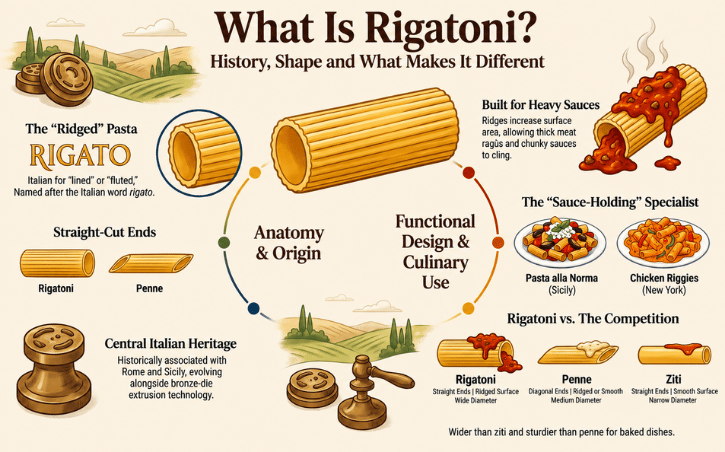
Rigatoni is a short, wide pasta tube with ridges running along its length and ends cut straight across rather than at an angle. That ridged surface isn’t decorative — it’s the entire reason the shape exists, giving thick sauces something to grip onto that a smooth tube never could.
What Rigatoni Actually Is
Rigatoni is a dried pasta shape made from durum wheat semolina and water, extruded through a die that presses the dough into a wide, hollow tube while cutting parallel or spiraling grooves into its outer surface. It’s larger in diameter than penne or ziti, and unlike penne, its ends are cut straight rather than on a diagonal, giving each piece a slightly stubbier, more uniform look.
The shape sits firmly in the category of “sauce-holding” pastas. The ridges increase surface area and create texture that a smooth tube lacks, so sauce clings to the outside as well as pooling inside the tube itself. That’s the practical reason rigatoni shows up so often in recipes built around thick, chunky, or meat-based sauces rather than thin, oil-based ones.
Where the Name Comes From
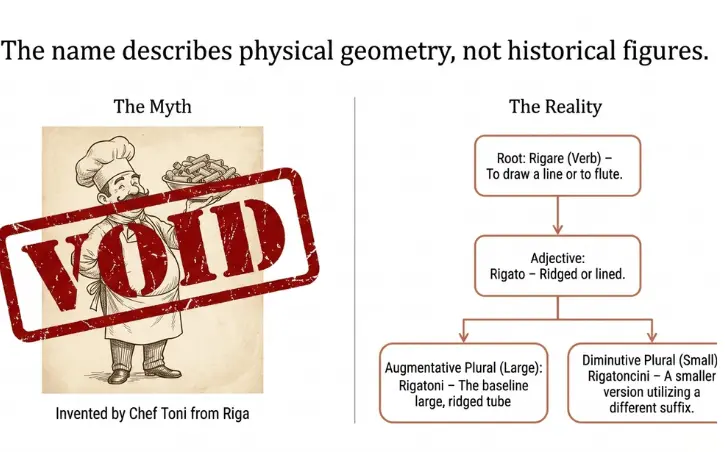
The name rigatoni comes from the Italian word rigato, meaning “ridged” or “lined,” which itself comes from rigare, “to draw a line” or “to flute.” Rigatoni is technically the plural of rigatone, an augmentative form indicating a larger size — the same pattern used elsewhere in Italian pasta naming, where a smaller version of the shape, rigatoncini, takes a diminutive suffix instead.
There’s a popular internet story claiming rigatoni was invented by a chef literally named Toni working in a town called Riga. That story isn’t supported by any etymological source and appears to be a joke that spread as if it were fact. The real origin of the name is much simpler and well documented: it’s a straightforward description of the pasta’s most obvious feature, its ridges, not a reference to a person or place.
Where Rigatoni Comes From
Rigatoni is associated with the cuisine of Rome and the wider central and southern regions of Italy, and it remains a particularly favoured shape in Sicily specifically. Unlike some pasta shapes with murkier or disputed histories, rigatoni’s story is less about a single invention moment and more about an evolution of pasta-extrusion technology — as bronze dies capable of cutting fine ridges into dough became standard in Italian pasta production, ridged tube shapes like rigatoni became common alongside their smooth counterparts.
How Rigatoni Compares to Similar Pasta Shapes
Rigatoni belongs to a family of tube-shaped pastas that are easy to confuse with one another. The differences come down to diameter, ridge depth, and how the ends are cut.
| Shape | Size (vs. rigatoni) | Ridges | End Cut | Origin Region |
|---|---|---|---|---|
| Rigatoni | Baseline | Ridged | Straight | Central/Southern Italy, Sicily |
| Penne | Similar or smaller | Ridged or smooth | Diagonal | Various regions |
| Ziti | Narrower, longer | Smooth | Straight (often broken before cooking) | Sicily |
| Tortiglioni | Larger, deeper grooves | Spiraled ridges | Straight | Italy (various) |
| Paccheri | Much larger diameter | Usually smooth (ribbed version exists) | Straight | Campania |
The practical takeaway: penne’s angled cut and often-smaller size make it better suited to lighter, oil- or cream-based sauces that can slide into the tube easily, while rigatoni’s straight cut and wider body hold up better under heavier, chunkier sauces that need to be scooped rather than twirled.
How Rigatoni Is Made
Commercial rigatoni is produced by mixing durum wheat semolina with water into a stiff dough, then forcing that dough through a metal die under pressure. The die’s ridged inner surface cuts the grooves into the pasta as it’s extruded, and a rotating blade cuts the tube to length as it emerges. The pasta is then dried slowly at controlled temperatures to preserve its texture and prevent cracking.
Fresh, homemade rigatoni is less common than fresh flat pasta shapes, since forming a ridged tube shape by hand is far more difficult than rolling and cutting a sheet. Most rigatoni sold and used, including in Italy, is a dried, factory-extruded product rather than a fresh pasta.
How Rigatoni Is Traditionally Served
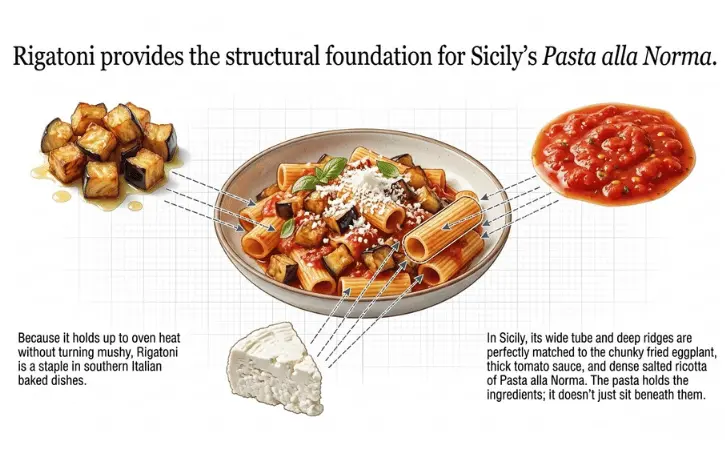
Rigatoni’s size and ridges make it a natural match for hearty, textured sauces: meat ragùs, baked pasta dishes, and vegetable-based sauces with some body to them. In Sicily, it’s a common base for pasta alla Norma, a dish built around fried eggplant, tomato, and salted ricotta, where the sauce’s chunkier ingredients need a wide tube to hold onto. It also appears frequently in baked pasta dishes, where its sturdy shape holds up well to oven heat without turning mushy.
Rigatoni has also found a place outside Italy through Italian-American cooking. Chicken riggies, a dish native to the Utica–Rome area of New York State, combines chicken, hot or sweet peppers, and a spicy tomato-cream sauce with rigatoni as its pasta base — a regional Italian-American dish rather than a traditional Italian one, but a well-documented example of how the shape traveled and adapted.
Why the Shape Matters
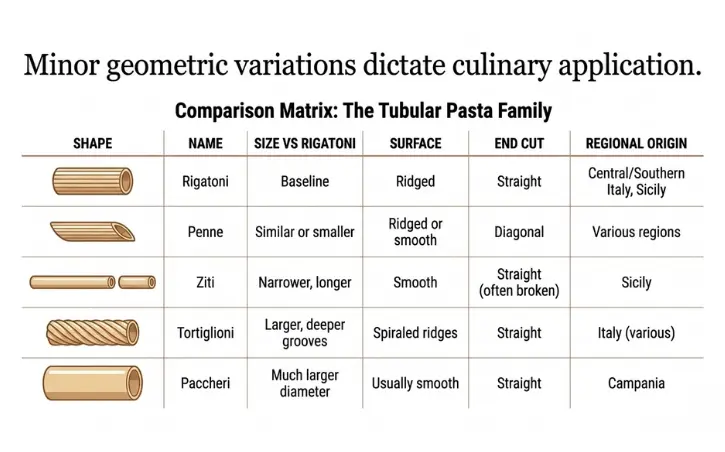
Rigatoni is a useful example of how pasta shapes in Italian cooking aren’t arbitrary — they’re functional tools matched to specific sauces and regional cooking styles. The ridges aren’t a stylistic flourish; they solve the practical problem of getting a thick sauce to stay on the pasta rather than pooling at the bottom of the bowl. That’s also why rigatoni and its close relatives, like penne and tortiglioni, differ from each other in small but deliberate ways rather than being interchangeable versions of the same idea.
Common Questions About Rigatoni
Is rigatoni the same as penne?
No. Rigatoni is generally wider, has straight-cut ends rather than diagonal ones, and always has ridges, while penne can be either ridged (penne rigate) or smooth (penne lisce).
Does rigatoni have egg in it?
Traditional dried rigatoni is made from durum wheat semolina and water only, without egg. Some fresh or specialty versions may include egg, but that’s not the standard recipe.
What sauces work best with rigatoni?
Thick, chunky, or meat-based sauces generally work better than thin, oil-based ones, since the wide tube and ridged surface are built to hold and carry heavier ingredients rather than let a thin sauce slide off.
The Bottom Line
Rigatoni is a ridged, straight-cut pasta tube built specifically to hold onto thick, hearty sauces — a shape whose name simply describes its most defining feature rather than referencing any inventor or legend. Reach for it over penne or ziti any time the sauce is chunky, meaty, or baked into the dish, and the shape will do exactly the job it was designed for.
