
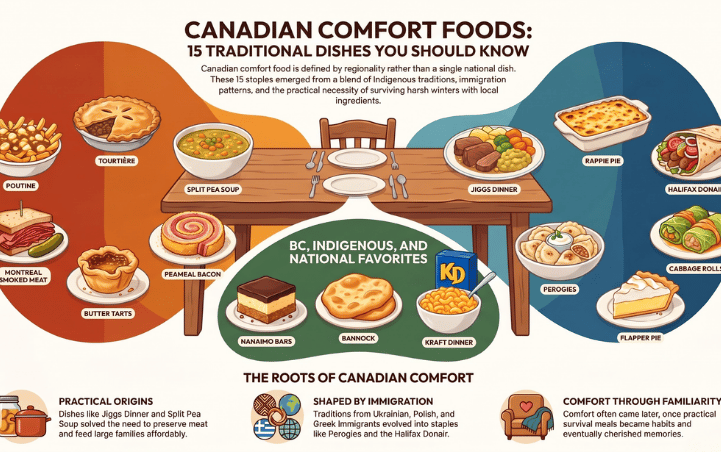
Ask ten Canadians to name the country’s ultimate comfort food and you’ll probably get ten different answers, shaped almost entirely by where they grew up. A Newfoundlander might say Jiggs dinner. Someone from Winnipeg may immediately choose perogies. In Montreal, smoked meat could easily win the argument.
That regional divide is really the point. Canadian comfort food was never built around a single national dish. Instead, it developed through Indigenous food traditions, immigration, local ingredients, harsh winters, and communities finding practical ways to feed their families.
From Quebec’s poutine to British Columbia’s Nanaimo bars, these 15 dishes show just how differently Canadians define comfort food.
Quebec
1. Poutine
Fries, cheese curds, and gravy sound simple, but a good poutine depends heavily on timing. The gravy needs to be hot enough to soften the cheese curds without completely melting them, leaving behind the slightly squeaky texture that Canadians expect.
Poutine emerged from rural Quebec snack bars in the late 1950s, and several towns still debate exactly who served it first. Whatever its precise origin, there is little question that poutine has become Quebec’s most internationally recognized dish.
2. Tourtière
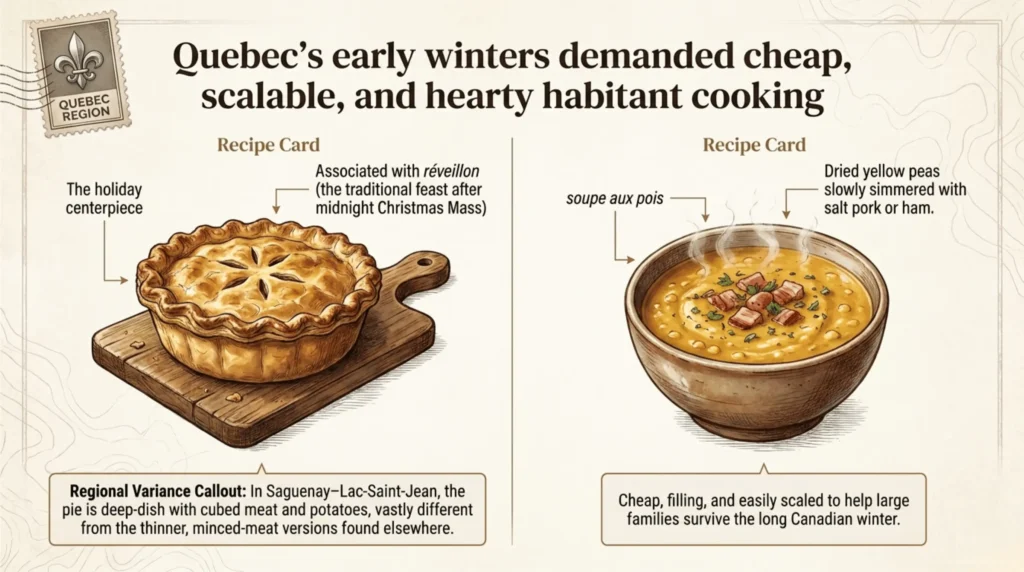
Tourtière is a traditional meat pie closely associated with Quebec and the holiday season. It is often served during réveillon, the late-night Christmas feast traditionally held after midnight Mass.
The filling can include pork, beef, or game, depending on the region and family recipe. In Saguenay–Lac-Saint-Jean, for example, tourtière is often much deeper and filled with cubed meat and potatoes, making it very different from the thinner, minced-meat versions found elsewhere in Quebec.
3. Split Pea Soup
Known in French as soupe aux pois, this thick golden soup is made from dried yellow peas slowly simmered with salt pork or ham.
It is one of the classic dishes associated with Quebec’s habitant cooking tradition. Cheap, filling, and easy to make in large quantities, split pea soup was exactly the kind of meal that could help a family get through a long Canadian winter.
4. Montreal Smoked Meat Sandwich
Piled high on rye bread and usually served with yellow mustard, Montreal smoked meat is one of the city’s most recognizable foods.
The dish developed within Montreal’s Jewish community, influenced by Eastern European traditions of brining, seasoning, and smoking beef. Over time, delicatessens helped turn smoked meat from a local specialty into a Montreal institution.
The result is a sandwich that is simple in appearance but deeply tied to the city’s immigration history and food culture.
Ontario
5. Butter Tarts
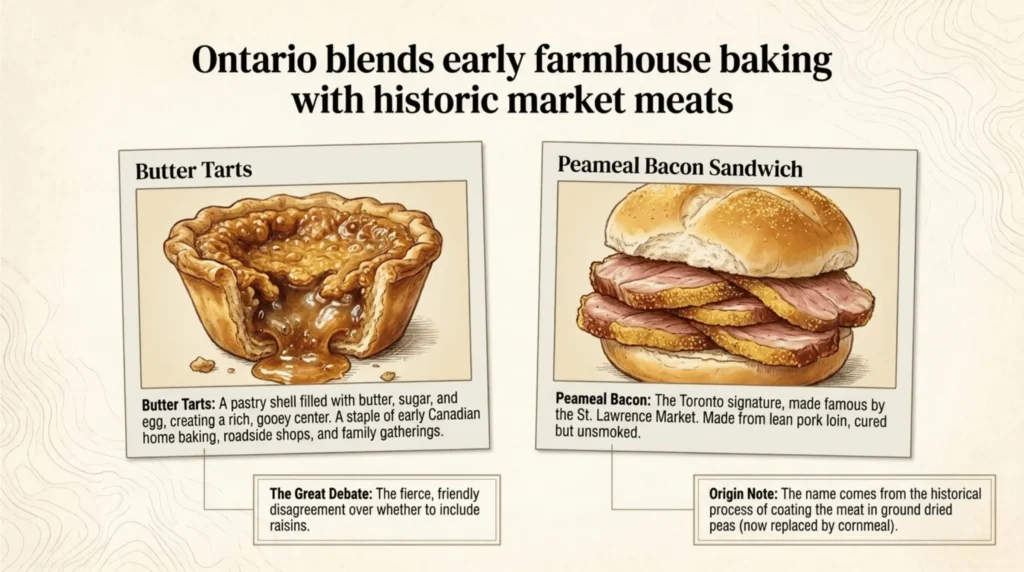
Few Canadian desserts inspire as much friendly disagreement as the butter tart.
At its simplest, it is a pastry shell filled with butter, sugar, and egg, creating a rich, gooey centre. The real debate begins when raisins or other additions enter the conversation.
Butter tarts are strongly associated with Ontario and early Canadian home baking. They remain a staple at bakeries, roadside shops, family gatherings, and community events across the province.
6. Peameal Bacon
Peameal bacon is closely associated with Toronto and is especially famous through the city’s St. Lawrence Market.
Unlike traditional American-style bacon, peameal bacon is made from lean pork loin, cured but not smoked, and coated in a layer of cornmeal. Its name comes from an earlier version of the process, when ground dried peas were used instead.
Served in a sandwich, often on a soft bun, it has become one of Toronto’s most recognizable comfort foods.
Atlantic Canada
7. Jiggs Dinner
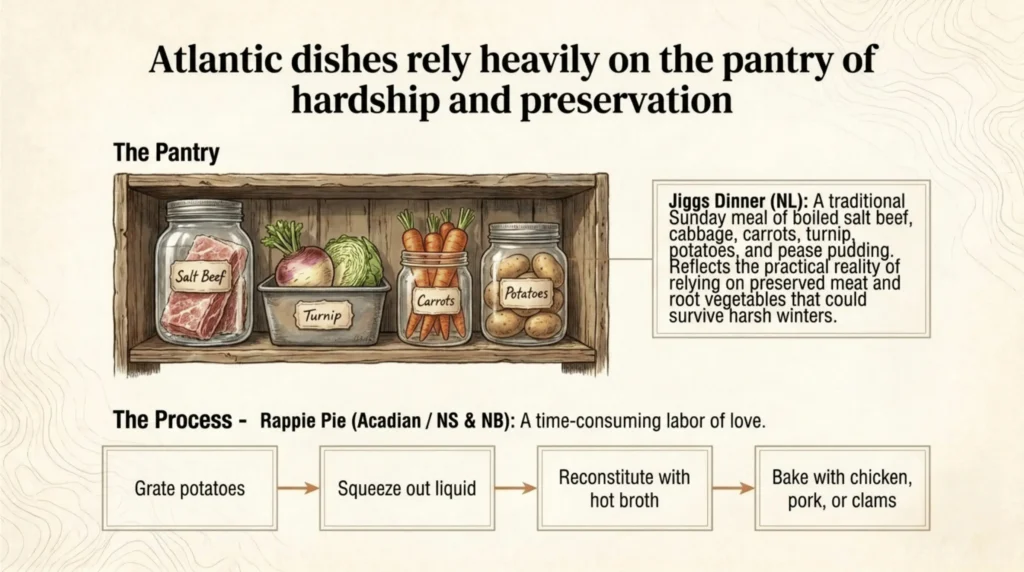
A traditional Sunday meal in Newfoundland and Labrador, Jiggs dinner typically includes boiled salt beef, cabbage, carrots, turnip, and potatoes, often served with pease pudding.
The dish reflects the practical realities of life in the region. Salted meat and root vegetables could be stored for long periods, making them reliable ingredients during harsh winters.
Today, Jiggs dinner remains more than just a historical recipe. For many Newfoundland families, it is still closely connected to Sunday meals and home cooking.
8. Rappie Pie
Rappie pie is a traditional Acadian dish found mainly in southwestern Nova Scotia and parts of New Brunswick.
It is made by grating potatoes, squeezing out their liquid, and then reconstituting them with hot broth before baking the mixture with chicken, pork, or sometimes clams.
The process is time-consuming and the finished texture can surprise first-time visitors, but for Acadian communities, rappie pie remains a deeply familiar and important comfort food.
9. Halifax Donair
The Halifax donair began as a local adaptation of the Greek gyro.
In the early 1970s, Greek immigrant Peter Gamoulakos developed a version better suited to local tastes, replacing lamb with spiced beef and introducing the now-famous sweet sauce made from condensed milk, garlic, and vinegar.
The combination became a Halifax institution. Today, the donair is so closely associated with the city that it is widely considered one of Canada’s most distinctive regional foods.
The Prairies
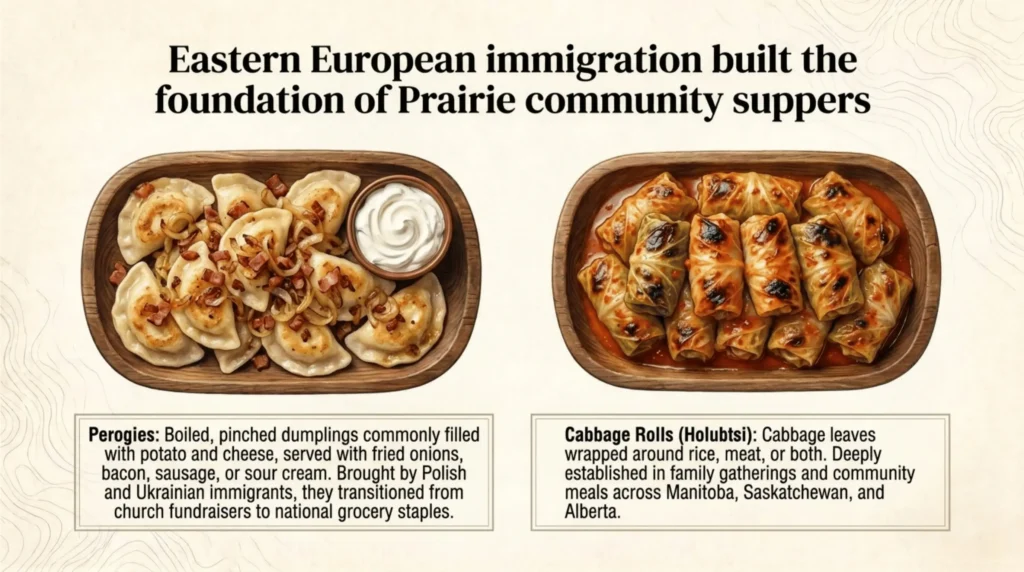
10. Perogies
Perogies became a major part of Prairie food culture through Polish and Ukrainian immigration.
These boiled, pinched dumplings are commonly filled with potato and cheese, although traditional fillings can vary. They are often served with fried onions, sour cream, bacon, or sausage.
Across Manitoba, Saskatchewan, and Alberta, perogies became fixtures at church suppers, family dinners, and community fundraisers before eventually becoming common in grocery store freezers across Canada.
11. Cabbage Rolls
Known as holubtsi in Ukrainian tradition, cabbage rolls consist of cabbage leaves wrapped around fillings that can include rice, meat, or both.
Like perogies, they became deeply established in Prairie communities through Eastern European immigration. The dish remains common at family gatherings and community meals, particularly in areas with strong Ukrainian and Polish heritage.
12. Flapper Pie
Flapper pie is a classic dessert from Manitoba and Saskatchewan.
It combines a graham cracker crust with vanilla custard and a layer of meringue. It is not especially elaborate, and that is part of its appeal.
For many Canadians who grew up on the Prairies, flapper pie is the kind of dessert associated with family kitchens, diners, and community cookbooks rather than restaurant menus.
British Columbia
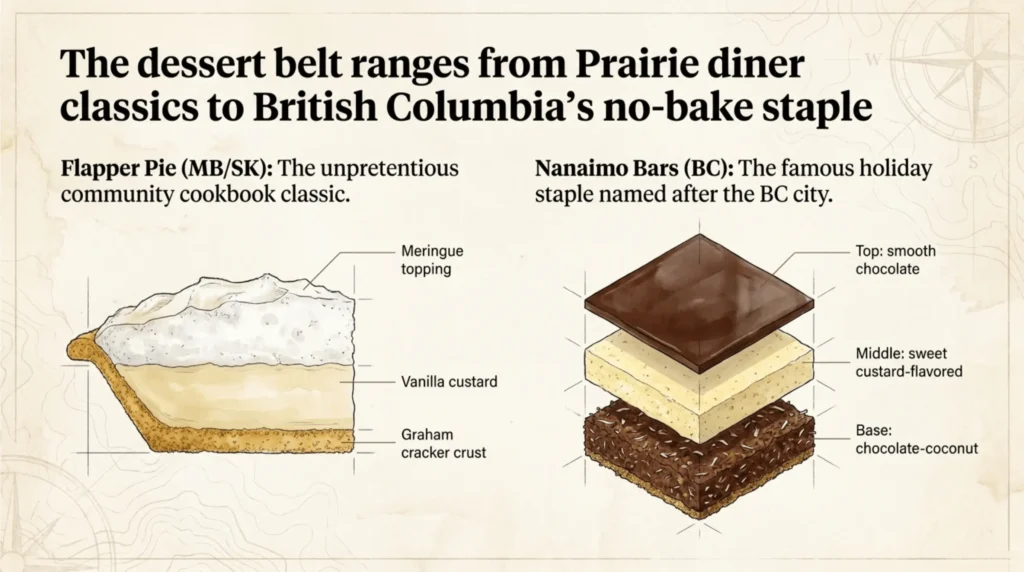
13. Nanaimo Bars
No list of Canadian comfort foods feels complete without Nanaimo bars.
Named after the city of Nanaimo in British Columbia, this no-bake dessert is built in three layers: a chocolate-coconut base, a sweet custard-flavoured middle, and a smooth chocolate topping.
The exact origin of the Nanaimo bar has been debated, but the dessert became closely associated with the British Columbia city whose name it now carries. Today, it is one of Canada’s best-known desserts and a regular feature of holiday baking and community cookbooks.
Indigenous Food Traditions
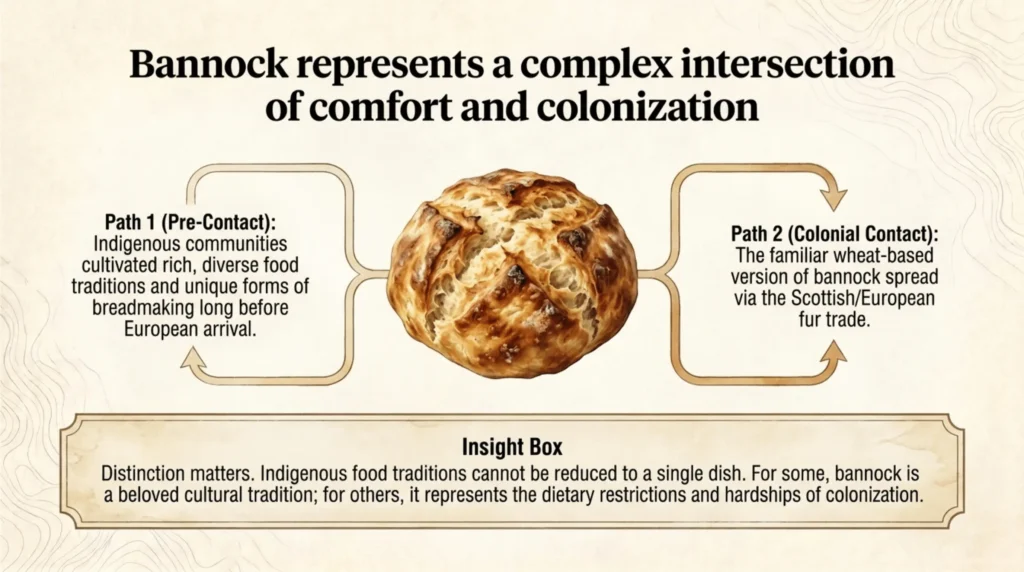
14. Bannock
Bannock is a bread that has been adopted and adapted in many Indigenous and Métis communities across Canada.
The familiar wheat-based version has historical connections to Scottish and European cooking and became widespread through fur trade and colonial contact. At the same time, Indigenous communities had their own food traditions and forms of breadmaking long before European contact.
That distinction matters. Indigenous food traditions are incredibly diverse and cannot be represented by a single dish. For some communities, bannock is a beloved comfort food and cultural tradition, while others connect certain versions of it to the hardships and restrictions of colonization.
A Canadian National Comfort Food
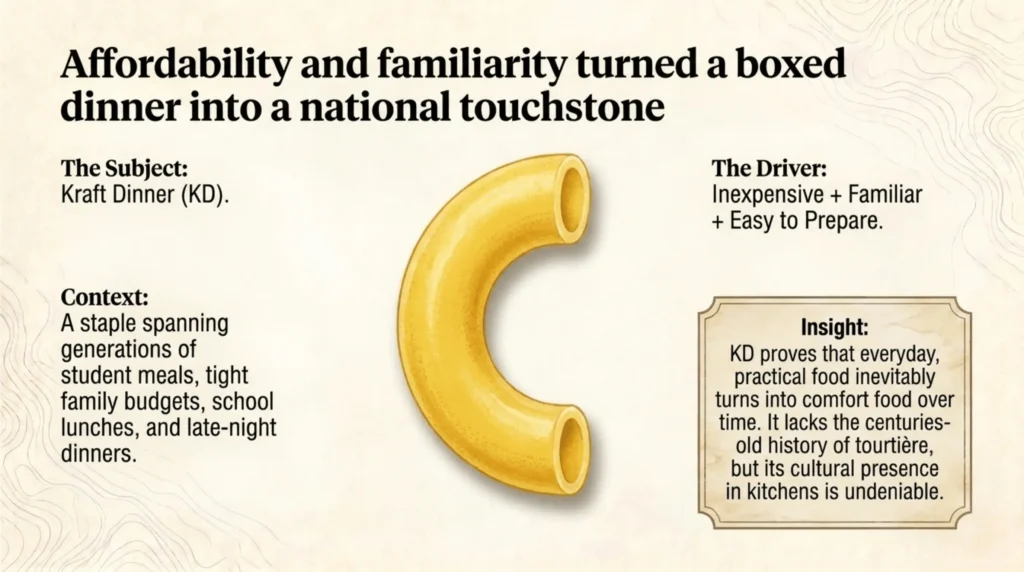
15. Kraft Dinner
Kraft Dinner may seem like an unusual choice for a list of traditional foods, but its place in Canadian comfort food culture is difficult to ignore.
For generations, boxed macaroni and cheese has been part of student meals, family budgets, school lunches, and late-night dinners. It is inexpensive, familiar, and easy to prepare — all qualities that tend to turn everyday food into comfort food over time.
It may not have the centuries-old history of tourtière or bannock, but its cultural place in Canadian kitchens is undeniable.
Why These Dishes Still Matter
What connects Jiggs dinner to Kraft Dinner isn’t flavour. It’s function.
Nearly every dish on this list began by solving a practical problem: how to preserve meat through winter, feed a large family affordably, make use of local ingredients, or recreate the taste of home after arriving in a new country.
The comfort often came later, once those practical meals became habits and eventually memories.
That is also why Canadian comfort food is so regional. Canada’s food culture did not develop around a single national identity or one defining dish. It developed through Indigenous food traditions, immigration, geography, climate, and communities adapting recipes to the ingredients they had available.
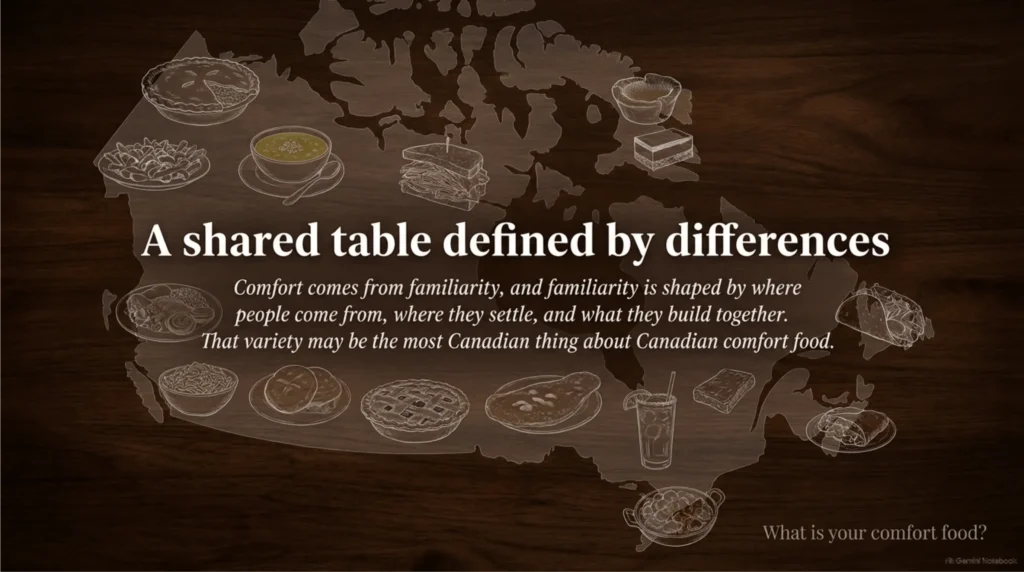
A plate of poutine, a Newfoundland Jiggs dinner, a Prairie perogy, and a Nanaimo bar may have very little in common on the surface. But together, they tell a larger story about Canadian food: comfort comes from familiarity, and familiarity is shaped by where people come from, where they settle, and what they build together.
That variety may be the most Canadian thing about Canadian comfort food.
